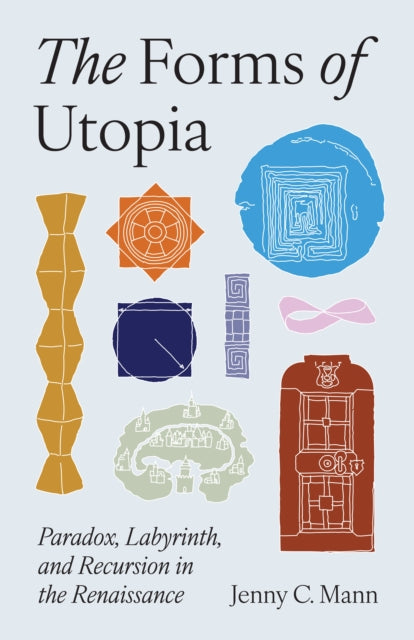
The Forms of Utopia : Paradox, Labyrinth, and Recursion in the Renaissance - Jenny C. Mann

The Forms of Utopia : Paradox, Labyrinth, and Recursion in the Renaissance - Jenny C. Mann

Jenny C. Mann

£30.00
Pre-order

Published 27 October 2026

Order now and we’ll post it on publication day. We take payment today and hold your order until then; if the publisher moves the date we’ll email you, and you can cancel for a full refund at any point before it ships.

  • Pages · 248 pages, 17 b/w illus.
  • Publication Date · 27/10/2026
  • Genre · Literature: history & criticism
Collect in store Pick it up free from the shop in Oxford's Covered Market, usually quicker than the post.
Delivery Standard tracked £1.99, free on orders over £20. Express tracked £2.99.
Book Lovers' Happy Hour Three cocktails matched to your taste, three books chosen for you, an hour and a half at the bar. £60 per person. Book a place →
A new analysis of utopia as a literary form, with recursive patterns that draw from early modern logic and mathematicsIn this ingenious and provocative book, Jenny Mann asks us to shift our understanding of utopia from its politics to its form. Beginning with Thomas More's Utopia (1516), one of the most influential books of all time, Mann shows that utopia's recursive patterns-its frames, folds, knots, meanders, and turns-enable the perpetual invention of limitless artificial worlds. Mann demonstrates how paradox, labyrinth, and recursion, in the hands of More, William Shakespeare, and Margaret Cavendish, become techniques of utopian invention. Drawing on concepts from logic and mathematics, including the Liar's Paradox and the conundrum of squaring the circle, to make sense of utopia's impossible geometries, she offers fresh and illuminating considerations of More's Utopia, Shakespeare's The Tempest, and Cavendish's The Blazing World, each representing a different form of utopia. These sections are framed by interludes that feature an artwork or artifact-an intarsia-paneled door, a turf maze, a silver coin-that materially expresses an element of utopia's puzzling structure. To study utopia, she argues, we must enter its structure and follow the disorienting paths. Utopia works by transforming enclosed spaces-a book, a play-into sites of infinite possibility.

Only at Gulp Fiction

Book Lovers' Happy Hour

An hour and a half at the bar, with three cocktails matched to your taste and three books chosen for you. Tell us what you like when you book, and we'll have them waiting when you arrive.

  • 1½ hours
  • £60 per person
  • 3 cocktails, 3 books
Book Happy Hour

Up to four of you can come — book a place each and choose the same time slot, then tell us who you're with. For larger groups, email gulpfictionbooks@gmail.com and we'll arrange it.

Three customers at the window table in Gulp Fiction, cocktails in hand beside a stack of books, with Oxford's Covered Market visible through the glass

Collect in store

Order online and pick it up from the shop. It's free, and usually quicker than the post.

Find us

Units 28–29, Covered Market, Oxford OX1 3DU. Mon–Wed 10–5, Thu–Sat 10–10, Sun 11–4.

Book a table

The bar is open late Thursday to Saturday. Reserve a table for a drink among the books.